
When cancer leaves only molecular traces, RaDaR ST brings them into view.
Personalized, tumor-informed molecular residual disease (MRD) detection
RaDaR ST is a personalized, tumor-informed MRD test that provides deeper, earlier molecular insights for risk stratification, treatment response, and recurrence monitoring.
What is RaDaR ST?
See deeper. Know earlier. Understand change over time.
RaDaR ST uses each patient’s tumor to create a personalized assay that selects and monitors up to 48 variants specific to the patient’s cancer. Serial blood testing then provides a personalized molecular view of disease dynamics over time.

See deeper
RaDaR ST detects ctDNA at exceptionally low levels, providing visibility beyond what conventional assessment may reveal.

Know earlier
RaDaR ST may detect molecular residual disease, treatment response, recurrence, or progression months before it becomes clinically or radiographically apparent.

Understand change over time
Serial RaDaR ST testing helps characterize ctDNA clearance, decline, persistence, or increase over time, providing a personalized molecular view of disease dynamics.
Exceptional Sensitivity for Confident MRD Detection1-4
- Up to 48 personalized variants
- Analytical LoD95 of 11 parts per million (ppm)
- ctDNA detection as low as 1 ppm under certain study-specific conditions
- Prioritizes high-confidence, often clonal, variants to reduce false negatives
- Minimizes false positives with error suppression, germline subtraction, and CHIP filtering
What can RaDaR ST be used for?
One test. Molecular insights across the continuum of care.
RaDaR ST has been clinically validated in 15 cancer types, across all stages of cancer and has demonstrated clinical performance across three clinical MRD use cases.
Risk stratification: What is the risk of recurrence?
MRD detection may complement traditional clinicopathologic risk assessment by identifying molecular evidence associated with a higher risk of recurrence
- Assess molecular residual disease after curative-intent treatment
- Refine recurrence-risk assessment
- Provide prognostic molecular insights to complement clinicopathologic factors
Treatment-response monitoring: Is treatment working?
Serial MRD testing tracks ctDNA levels over time to provide molecular insight into treatment response and disease dynamics.
- Establish baseline ctDNA detection while the primary tumor is present or when tumor burden is highest
- Characterize molecular response during and after neoadjuvant or adjuvant therapy or therapy for advanced or metastatic cancers
- Monitor response, disease control, or progression during treatment
- Complement imaging and clinical evaluation with a personalized molecular view
Recurrence monitoring: Is cancer coming back?
MRD testing can detect molecular recurrence during surveillance, potentially before clinical or radiographic evidence of disease.
- Monitor for molecular recurrence following definitive treatment
- Complement imaging and clinical evaluation
- Detect recurrence systemically
- Follow molecular disease status longitudinally through serial testing
How is RaDaR ST used?
Personalized at baseline. Designed for longitudinal monitoring.
RaDaR ST combines a tumor-informed baseline with serial blood testing to follow molecular disease over time.
Establish the personalized assay – 1st timepoint
Tumor tissue undergoes whole-exome sequencing to identify and prioritize high-confidence, often clonal, patient-specific variants.
First test specimen requirements
- Tumor tissue: 10 unstained slides plus 1 unstained slide for H&E, or an eligible tumor block
- Blood: two 10 mL Streck Cell-Free DNA BCT® tubes
- Pathology report
NeoGenomics will work with you and your pathology team to help ensure samples meet specimen requirements and support timely results.
Monitor with serial blood testing – follow-up timepoints
Once the personalized assay has been established, follow-on tests require blood only.
- Two 10 mL Streck Cell-Free DNA BCT tubes
- No additional tumor tissue required
- Testing cadence can be selected on the test request form and changed as clinically appropriate
Testing frequency should be determined at the provider’s discretion based on the clinical setting, available clinical-utility data, and the patient’s insurance coverage.
Interpret clear, longitudinal results
RaDaR ST reports whether tumor DNA was detected or not detected in the patient’s most recent blood sample.
When tumor DNA is detected, the report includes the estimated variant allele fraction—the proportion of tumor-derived DNA relative to total cell-free DNA.
For patients with multiple timepoints, the report displays results longitudinally, helping clinicians visualize ctDNA trends and understand how molecular disease status changes over time.
TUMOR DNA DETECTED
Patient-specific ctDNA was detected in the blood sample.
TUMOR DNA NOT DETECTED
Patient-specific ctDNA was not detected in the blood sample. A not-detected result should be interpreted together with clinical findings, imaging, and other relevant information.
RaDaR ST is designed for accurate and efficient MRD testing

Enhanced accuracy
Proprietary methods prioritize high-confidence, often clonal, variants to reduce false negatives. Error suppression, germline subtraction, and CHIP filtering minimize false positives.

Low sample requirements
- First test: tumor tissue and two blood tubes
- Follow-on tests: two blood tubes only

Fast turnaround time
- Baseline results in as little as 28 days
- Follow-on results in as little as 7 days
- Median tissue-retrieval turnaround time: 3 days
Coverage that counts. Access that matters.
Broad and expanding access to RaDaR ST
NeoGenomics maintains more than 300 in-network commercial insurance contracts.
RaDaR ST is covered by Medicare for eligible patients across multiple solid-tumor indications, including select breast cancer, colorectal cancer, head and neck cancer, and immunotherapy-response monitoring uses.
Coverage and patient eligibility vary by indication and individual payer policy.
HNSCC |
|
Breast |
|
Immunotherapy monitoring |
|
Colorectal |
|
Comprehensive support for patients and providers
Mobile phlebotomy
Patients may choose a clinic location or an in-home blood draw through our national mobile phlebotomy program. Blood draws are performed by licensed phlebotomists and offered at no cost to cancer patients.
Dedicated customer support
Teams trained in RaDaR ST can help navigate test information, specimen requirements, turnaround times, patient results, and more.
Billing and financial support
NeoGenomics works with patients and their insurance companies to support access to high-quality cancer testing and offers financial-assistance programs for eligible patients.
References
Elliott, M.J., et al. "Longitudinal Evaluation of Circulating Tumor DNA in Patients Undergoing Neoadjuvant Therapy for Early Breast Cancer Using a Tumor-Informed Assay." Nature Communications, vol. 16, no. 1, 2025, article 1837.
Flach, S., et al. "Personalized ctDNA Analysis for Detection of Residual Disease and Recurrence in Surgically Treated HNSCC Patients." NPJ Precision Oncology, vol. 10, no. 1, 2026, p. 103.
Flach, S., et al. "Liquid BIOpsy for MiNimal RESidual DiSease Detection in Head and Neck Squamous Cell Carcinoma (LIONESS)-A Personalised Circulating Tumour DNA Analysis in Head and Neck Squamous Cell Carcinoma." British Journal of Cancer, vol. 126, 2022, pp. 1186–1195.
NeoGenomics data on file.
RaDaR® ST – Closing the Clinical Gap in Breast Cancer
Recurrence starts at the molecular level. So does MRD monitoring.
Across breast cancer subtypes and stages, assessing recurrence risk, treatment response, and monitoring for recurrence remain challenging. Molecular residual disease (MRD) may be present even when it is not apparent through conventional clinicopathologic risk assessment, imaging, and clinical evaluation.
In over 20 publications and 7 completed breast cancer studies, RaDaR ST has demonstrated clinical validity across all breast cancer subtypes and MRD use cases for risk stratification, treatment response monitoring, and recurrence monitoring during surveillance.1-8
RaDaR ST provides earlier and deeper molecular insights across the breast cancer care continuum
MRD testing with RaDaR ST looks beyond what conventional assessments alone may reveal and provides a personalized molecular view of ctDNA dynamics over time.

Deeper insight into recurrence risk
RaDaR ST detects ctDNA down to 1ppm, beyond the limits of imaging.(1-4*)
Detect recurrence earlier
RaDaR ST detected molecular recurrence with a median lead time of over a year before clinical recurrence. (2,8)

Monitor response over time
Monitor molecular response and disease burden dynamics longitudinally.(2-8)

Detect recurrence systemically
Identify molecular recurrence regardless of where disease emerges.(2,6, 8)
Molecular insight for distinct breast cancer challenges
| After surgery: refine recurrence-risk assessment MRD testing with RaDaR ST in the postoperative setting, before treatment, may help refine recurrence risk and complement clinicopathologic risk assessment by identifying molecular evidence associated with a higher risk of recurrence. | During treatment: understand molecular response to treatment Serial ctDNA testing may provide deeper and earlier insight into response assessment and help characterize molecular response and residual disease dynamics during neoadjuvant or adjuvant therapy. | During surveillance: detect molecular recurrence earlier Across multiple early-stage breast cancer studies, recurrent ctDNA identified patients at higher risk and preceded clinical or radiographic recurrence.1-5 |
In the Cabel et al. study of patients with stage II–III high-risk early breast cancer.5
| In the TRACER study of stage I-III breast cancer patients receiving neoadjuvant therapy (NAT):2
| In the Cabel et al. study of patients with stage II–III high-risk early breast cancer.5
|
RaDaR ST – addresses HR+/HER2- breast cancer long-term recurrence risk months before conventional methods.
Hormone receptor (HR+) positive/HER2 negative tumors represent nearly 70% of breast cancer diagnoses and pose a unique clinical challenge. Unlike other breast cancer subtypes, late recurrences are common in patients with HR+/HER2- tumors, with over half of metastatic recurrences occurring 5+ years post-initial diagnosis. The risk of recurrence remains high for these patients for at least 20 years after curative-intent treatment. This creates a significant unmet need, as current methods cannot detect breast cancer recurrence until tumors present on scans—missing the critical intervention window when disease burden is minimal, and treatment is most likely to succeed.
RaDaR ST provides over a year of advanced warning of distant metastasis, opening the door to life-changing interventions.
The test detects early evidence of recurrence, well before the tumor becomes metastatic, detecting 100% of distant metastatic recurrences in a 3.9-year study of 83 patients, with a remarkable median lead time of 12.4 months before clinical detection—providing an unprecedented window to intervene when disease burden is minimal, and treatment may be most effective.1 For high-risk HR+/HER2- early-stage breast cancer patients, RaDaR ST extends vigilance beyond the early years to the long-term survival window by enabling continuous molecular surveillance in the late adjuvant setting, addressing the persistent threat of late recurrence that imaging alone may miss until it's too late.
Additionally, when endocrine-responsive biomarkers indicate high recurrence risk despite anti-estrogen therapy, integrating RaDaR ST testing can refine treatment decisions by detecting and monitoring circulating tumor DNA for more comprehensive risk assessment.
HR+/HER2- Breast cancer care continuum
From diagnosis through surveillance: delivering timely, actionable insights so that every treatment decision is as personal as the patients themselves.

RaDaR ST – closing the clinical gap in triple-negative breast cancer (TNBC)
Triple-negative breast cancer carries a substantial risk of early recurrence. Nearly 1 in 3 patients with high-risk stage II–III TNBC experienced a disease-related event despite curative-intent multimodality treatment.9
Current surveillance is largely symptom-directed and includes annual mammography. While mammography can help identify local breast events, TNBC recurrence frequently presents as distant metastatic disease, highlighting the need for a systemic approach to monitoring high-risk patients.9-11
RaDaR ST provides earlier and deeper molecular insights across the TNBC continuum of care
RaDaR ST may provide personalized, deeper, and earlier molecular insights from postoperative risk assessment through treatment-response and recurrence monitoring.

After surgery:
Identify molecular evidence associated with a higher risk of recurrence (2,5,6)

During treatment:
Monitor molecular response and changing disease burden over time (2,5,6)
During surveillance:
Detect molecular recurrence that may precede clinical or radiographic recurrence (2,5,7)

Systemically:
Identify molecular recurrence regardless of where disease emerges (4-7)
Recent studies
In the OXEL study of patients with residual TNBC following neoadjuvant therapy:6
- Postoperative ctDNA positivity identified patients at greatest risk of recurrence.
- Patients who were ctDNA-positive at landmark assessment had inferior median invasive disease-free survival (iDFS 4.52 months) compared to patients who were ctDNA-negative (iDFS not reached, P<0.0001).
In the c-TRAK-TN study of patients with stage II-III TNBC, RaDaR ST demonstrated:7
- 95.7% sensitivity to detect relapse
- 91% specificity for relapse
- 96.8% negative predictive value
References
NeoGenomics data on file
Elliott MJ, Echelard P, Pipinikas C, et al. Longitudinal evaluation of circulating tumor DNA in patients undergoing neoadjuvant therapy for early breast cancer using a tumor-informed assay. Nat Commun. 2025;16(1):1837. Published 2025 Feb 21. doi:10.1038/s41467-025-56658-4
Flach, S., et al. "Personalized ctDNA Analysis for Detection of Residual Disease and Recurrence in Surgically Treated HNSCC Patients." NPJ Precision Oncology, vol. 10, no. 1, 2026, p. 103.
Flach, S., et al. "Liquid BIOpsy for MiNimal RESidual DiSease Detection in Head and Neck Squamous Cell Carcinoma (LIONESS)-A Personalised Circulating Tumour DNA Analysis in Head and Neck Squamous Cell Carcinoma." British Journal of Cancer, vol. 126, 2022, pp. 1186–1195.
Cabel L, An JAR, Kim HK, et al. Monitoring of circulating tumor DNA in patients with stage II-III breast cancer treated with neoadjuvant chemotherapy. npj Breast Cancer. 2026;12:22. doi:10.1038/s41523-025-00878-w
Lynce, F., et al., Adjuvant nivolumab, capecitabine or the combination in patients with residual triple-negative breast cancer: the OXEL randomized phase II study. Nat Comms, 2024.
Coakley, Maria, et al. "Comparison of Circulating Tumor DNA Assays for Molecular Residual Disease Detection in Early-Stage Triple-Negative Breast Cancer." Clinical Cancer Research, vol. 30, no. 4, 15 Feb. 2024, pp. 895–903, doi:10.1158/1078-0432.CCR-23-2326.
Lipsyc-Sharf M., et al. Circulating Tumor DNA and Late Recurrence in High-Risk Hormone Receptor-Positive, Human Epidermal Growth Factor Receptor 2-Negative Breast Cancer. J Clin Oncol. 2022;40(22):2408-2419. doi:10.1200/JCO.22.00908
Schmid P, Cortes J, Dent R, et al. Final analysis of KEYNOTE-522 in high-risk early-stage triple-negative breast cancer. Presented at ASCO 2026
Nahleh Z, Alfano CM, Somerfield MR, et al. Breast cancer follow-up and surveillance after primary treatment: ASCO guideline update. J Clin Oncol. 2026. doi:10.1200/JCO-26-01700.
Vanderplas A, Hughes ME, et al. Clinicopathological features, patterns of recurrence, and survival among women with triple-negative breast cancer in the National Comprehensive Cancer Network. Cancer. 2012;118(22):5463-5472. doi:10.1002/cncr.27581.
RaDaR ST for Head & Neck Cancer
Closing the Surveillance Gap in HPV-Negative Head & Neck Cancer
HPV-negative head and neck squamous cell carcinoma (HNSCC) presents a significant clinical challenge, with many patients developing disease recurrence and fewer than 50% surviving beyond five years. HPV-negative patients face worse outcomes compared to their HPV-positive counterparts, and unlike HPV-positive disease, reliable biomarkers for therapy planning and monitoring treatment response do not exist for this population.
Current head and neck cancer adjuvant therapy monitoring and surveillance cannot answer two critical questions:
- Did surgery remove all the cancer?
- Are there ways to identify disease before clinical or radiographic signs appear?
This gap in monitoring leaves clinicians and patients without the tools needed to detect recurrence early when intervention may be most effective.
Earlier detection to support salvage treatment success
RaDaR ST delivers unprecedented sensitivity in detecting HPV-negative HNSCC recurrence, achieving 100% detection of relapsed patients by identifying ctDNA at ultra-low levels of 5ppm—ensuring no patient with recurrent disease goes undetected during the critical surveillance window.
Post-surgical ctDNA monitoring identifies disease relapse a median of 154 days (over 5 months) before clinical confirmation, providing crucial lead time when salvage surgery and radiation are most likely to succeed and before symptoms impact quality of life.
This sensitivity advantage is essential, as nearly one-third of positive samples had variant allele frequencies below 0.01%. It demonstrates standard sensitivity assays may miss a significant proportion of HNSCC relapse leaving patients to present with more advance disease.
Head and neck cancer care continuum
From diagnosis through surveillance: delivering timely, actionable insights so that every treatment decision is as personal as the patients themselves.

Case study: When salvage treatment success rates are highest
When a 60-year-old man noticed a growing lump on his neck, he went to his doctor for evaluation. His medical history included 30 years of smoking and alcohol use, and his physical examination revealed a large, firm mass on the left side. A subsequent biopsy confirmed p16-negative squamous cell carcinoma. Imaging showed the cancer was still localized, and he underwent surgery to remove the mass.
Four weeks post-surgery, despite clear resection margins, RaDaR ST testing detected ctDNA in his blood. Additional surgery was performed within days, and his postoperative ctDNA levels dropped to undetectable. The patient continued regular monitoring with both imaging and RaDaR ST every 3 months. The patient's ctDNA appeared 9 months after surgery but imaging did not detect it until 6 months after RaDaR ST. The residual disease was identified by RaDaR ST months before imaging.*
*Data on file
References
Flach S, Howarth K, Hackinger S, et al. Liquid BIOpsy for MiNimal RESidual DiSease Detection in Head and Neck Squamous Cell Carcinoma (LIONESS)-a personalised circulating tumour DNA analysis in head and neck squamous cell carcinoma. Br J Cancer. 2022;126(8):1186-1195. doi:10.1038/s41416-022-01716-7
No visible disease. Hidden risk. Deeper answers.
Following curative-intent surgery, many patients appear disease-free based on imaging and pathologic assessment. However, patients with similar clinicopathologic features can have markedly different recurrence risks, and molecular residual disease may be present even when imaging appears clear.1,2
RaDaR® ST provides personalized molecular insight to complement recurrence-risk assessment, monitor molecular response, and detect molecular recurrence during surveillance.3-6
Look beyond what conventional assessment alone may reveal
With LoD95 of 11 ppm, and detection down to 1 ppm, RaDaR ST can detect up to 37% more patients compared to an assay with a 100 ppm limit of detection.3-6
Imaging and pathologic assessment may show:
- No radiographic evidence of disease
- Favorable clinicopathologic features
- A patient who appears disease-free
MRD testing may reveal a different molecular picture.
 | ctDNA not detected is associated with:
May support treatment de-escalation when clinicopathologic risk is also low |
 | ctDNA detection is associated with:
|
RaDaR ST results
RaDaR ST results should be interpreted together with clinicopathologic factors for recurrence risk assessment and with imaging, cancer biomarkers, and other relevant clinical information for treatment response and recurrence monitoring.
Recurrence starts at the molecular level. So does MRD monitoring.
RaDaR ST may provide earlier, deeper molecular insights into recurrence-risk assessment, treatment response, and recurrence monitoring during surveillance.

After surgery refine recurrence-risk assessment
Postoperative MRD testing may complement clinicopathologic recurrence-risk assessment and provide additional information to help inform treatment decisions.

During treatment: assess molecular response
Serial RaDaR ST testing provides a personalized view of ctDNA dynamics during therapy.
During surveillance: detect molecular recurrence earlier
Serial MRD testing may complement imaging and cancer biomarkers during postoperative surveillance.
RaDaR ST provides clinically validated, ultrasensitive ctDNA detection
RaDaR ST is a tumor-informed, personalized MRD assay designed to detect molecular residual disease (MRD) with exceptional sensitivity and specificity, enabling more confident decisions across the cancer care continuum.
Strong performance in resectable CRC
In patients with stage II–IV resectable CRC, RaDaR ST demonstrated strong concordance and quantitative correlation compared with another tumor-informed MRD test:
- Greater than 95% concordance, with R >0.96 and P <0.0017
Interpret study-specific results in the context of the study design, population, sampling schedule, and follow-up.
Reinert T, et al. Analysis of plasma cell-free DNA by ultradeep sequencing in patients with stages I to III colorectal cancer. JAMA Oncol. 2019;5(8):1124-1131.
Parikh AR, et al. Minimal residual disease detection using a plasma-only circulating tumor DNA assay in patients with colorectal cancer. Clin Cancer Res. 2021;27(20):5586-5594.
Elliott MJ, et al. Longitudinal evaluation of circulating tumor DNA in patients undergoing neoadjuvant therapy for early breast cancer using a tumor-informed assay. Nat Commun. 2025;16(1):1837.
Flach S, et al. Liquid biopsy for minimal residual disease detection in head and neck squamous cell carcinoma (LIONESS): a personalized circulating tumour DNA analysis in head and neck squamous cell carcinoma. Br J Cancer. 2022;126:1186-1194.
Flach S, et al. Personalized ctDNA analysis for detection of residual disease and recurrence in surgically treated HNSCC patients. npj Precis Oncol. 2026;10(1):103.
NeoGenomics data on file.
Smith CG, et al. Exploration of tumor-informed ctDNA detection and dynamics in a real-world cohort of colorectal cancer patients from the MD Anderson Cancer Center. J Clin Oncol. 2026;44:e15658.
RaDaR® ST—Immunotherapy response monitoring
When imaging alone doesn’t tell the whole story
Assessing response to immunotherapy can be challenging. Pseudoprogression, delayed response, and mixed response may make conventional imaging difficult to interpret and complicate clinical decision-making. However, patients may derive meaningful clinical benefit from immunotherapy despite delayed, mixed, or perceived radiographic progression.
RaDaR ST provides a personalized molecular view of ctDNA dynamics over time, helping characterize immunotherapy response alongside imaging and clinical evaluation.1,2,3
Order RaDaR ST for Immunotherapy response moitoringDownload the Immunotherapy brochure
From imaging uncertainty to molecular insight

Changes in ctDNA may provide insight into treatment response before those changes are visible through imaging.1,2,3
Early ctDNA decrease or clearance has been associated with improved disease-free survival, progression-free survival, and overall survival compared with no molecular response1,2,3
Serial ctDNA monitoring provides an additional molecular view of treatment response and disease dynamics over time. Interpret results alongside imaging, clinical evaluation, and other relevant patient information.1,2,3
What longitudinal ctDNA monitoring may reveal
Across multiple studies, ctDNA clearance and decreasing ctDNA identified patients benefiting from immunotherapy, while persistent or increasing ctDNA provided an early indication of limited molecular response.1,2,3
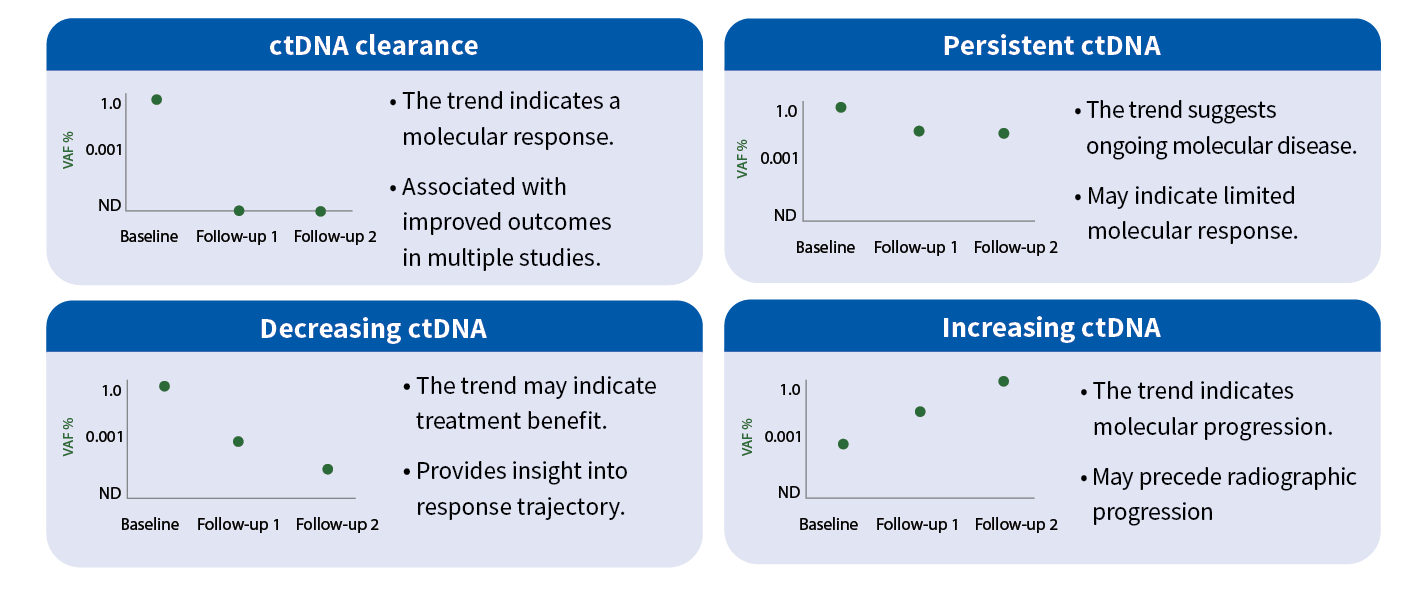
Molecular response assessment with RaDaR ST across immunotherapy settings
Serial molecular monitoring with RaDaR ST may help distinguish patients experiencing treatment benefit from those with persistent or progressive molecular disease. RaDaR ST has demonstrated clinical performance in immunotherapy response monitoring across the continuum of cancer care.1,2,3

Neoadjuvant immunotherapy
In the NABUCCO study of patients with stage III muscle-invasive bladder cancer receiving neoadjuvant immunotherapy:
Patients who achieved ctDNA clearance after neoadjuvant immunotherapy and before surgery demonstrated approximately 45-fold greater odds of achieving a pathologic complete response.
ctDNA clearance was strongly associated with improved progression-free survival and overall survival.1
Adjuvant immunotherapy
In the OXEL study of patients with residual TNBC following neoadjuvant therapy and treated with adjuvant nivolumab and/or capecitabine, ctDNA identified patients at greatest risk and led to worse clinical outcomes.
Postoperative ctDNA positivity identified patients at greatest risk of recurrence.
Patients who were ctDNA-positive at landmark assessment had inferior median invasive disease-free survival compared with patients who were ctDNA-negative.
All ctDNA-positive patients who failed to clear ctDNA by week 6 experienced recurrence. 2
Advanced or metastatic disease
In the Ruiz-Torres et al. study, patients with recurrent or metastatic head and neck squamous cell carcinoma receiving immunotherapy, ctDNA dynamics were strongly associated with disease control and clinical outcomes:
Patients who achieved ctDNA clearance during treatment had approximately 22-fold greater odds of disease control.
ctDNA clearance during immunotherapy treatment was associated with a 97% lower risk of disease progression (HR 0.03, P=0.006) and a 96% lower risk of death (HR 0.04, P=0.003).³
RaDaR ST is not intended to replace imaging or clinical evaluation. It provides an additional, personalized molecular view that may help clinicians:
Characterize treatment response over time
Identify molecular response or progression earlier
Add context when imaging findings are uncertain
Better understand disease dynamics during immunotherapy
RaDaR ST results should be interpreted together with imaging, clinical evaluation, treatment history, and other relevant clinical information.
Approved immunotherapy-response assessment reference supporting pseudoprogression, delayed response, and mixed response.
van Dorp J, et al. High- or low-dose preoperative ipilimumab plus nivolumab in stage III urothelial cancer: the NABUCCO study. Nat Med. 2023;29:588–592.
Ruiz-Torres S, et al. Longitudinal ctDNA dynamics and response to immune-checkpoint blockade in recurrent/metastatic head and neck squamous cell carcinoma.